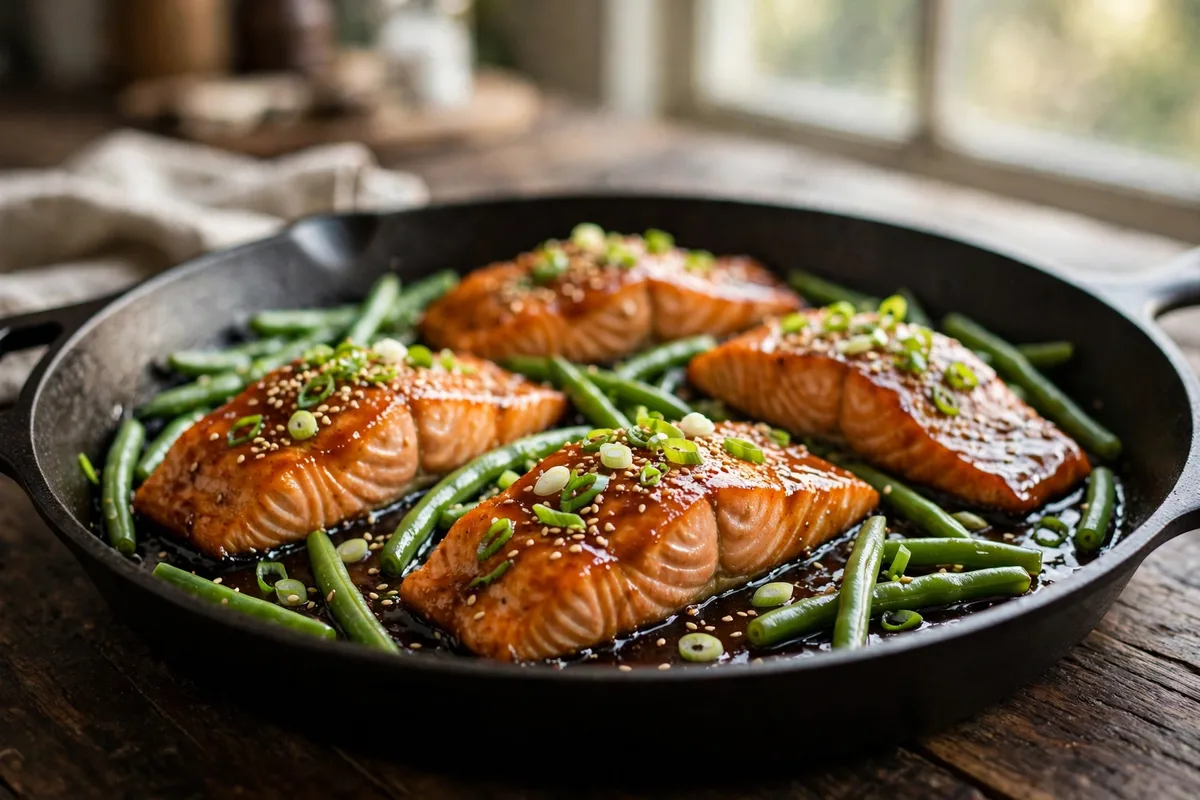
One-Pan Teriyaki Salmon and Green Beans (30 Minutes)
Teriyaki salmon sounds far more involved than it is: a glossy, sweet-savoury glaze, crisp-tender green beans and flaky salmon, all in one pan, all in 30 minutes, with no oven and no marinade to plan around.
This version is fully stovetop. The salmon is seared skin-side down until the skin turns crisp, then set aside while the green beans cook in the same pan. The teriyaki sauce is built straight in the skillet from soy sauce, honey, rice vinegar, garlic and fresh ginger, thickened with a cornstarch slurry and reduced until it coats a spoon. Nothing is baked, nothing is marinated, and there is only one pan to wash.
That is the point of this recipe. The top-ranking result finishes the salmon in the oven, the next is a stir-fry that needs a 15-minute marinade before cooking starts, and the rest are sheet-pan or noodle versions. No true 30-minute stovetop-only teriyaki salmon skillet sits on page one — this one does, fridge to plate in half an hour, with the sauce made in the pan you cooked in.
Prep time: 10 minutes (estimate)
Cook time: 20 minutes (estimate)
Total time: 30 minutes (estimate)
Servings: 4
Recipe at a glance
Prep time: 10 minutes (estimate)
Cook time: 20 minutes (estimate)
Total time: 30 minutes (estimate)
Servings: 4
Method: stovetop only — no oven, no marinade
Pan: one large skillet, 12 inches or wider
Main flavours: soy sauce, honey, ginger, garlic, sesame
Why this recipe works
Teriyaki sauce is a balance of salty, sweet and sharp. Soy sauce brings the salt and depth, honey brings the sweetness and the shine, rice vinegar cuts through both so the glaze never tastes flat, and garlic and fresh ginger give it warmth. A cornstarch slurry thickens the sauce in under a minute, so it clings to the salmon instead of pooling on the plate.
Searing the salmon skin-side down first is the other half of the method. A hot, lightly oiled pan and a dry fillet surface give the skin time to crisp while the flesh cooks gently from below. Flipping once, briefly, finishes the top without drying the fish out. The salmon is then set aside while the beans cook in the same pan.
Equipment
- Large skillet, 12 inches or wider, with a lid
- Tongs and a spatula
- Instant-read thermometer
- Small bowl and whisk or fork, for the cornstarch slurry
- Measuring cups and spoons
- Sharp knife and chopping board
- Paper towels, for patting the salmon dry
Ingredients
For the salmon and green beans
- 4 salmon fillets, about 6 oz each, skin on or off
- 12 oz green beans, trimmed
- 1 tablespoon vegetable oil or other neutral oil
- ½ teaspoon kosher salt
- ¼ teaspoon black pepper
- 2 tablespoons water, for steaming the green beans
- 1 teaspoon sesame oil
- 1 tablespoon sesame seeds, for serving
- 2 spring onions, thinly sliced, for serving
For the teriyaki sauce
- ⅓ cup low-sodium soy sauce
- 3 tablespoons honey
- 2 tablespoons rice vinegar
- 2 tablespoons water
- 3 cloves garlic, finely grated or minced
- 1 tablespoon fresh ginger, finely grated
- 1 tablespoon cornstarch
- 1 tablespoon cold water, for the slurry
Instructions
- Prepare the salmon. Take the salmon out of the fridge 10 minutes before cooking so it loses its chill. Pat each fillet thoroughly dry on all sides with paper towels — a dry surface is what lets the skin crisp instead of steam. Season with the kosher salt and black pepper.
- Mix the sauce base. In a small bowl, whisk together the soy sauce, honey, rice vinegar, 2 tablespoons of water, garlic and ginger. In a separate small bowl, stir the cornstarch into 1 tablespoon of cold water until smooth, with no lumps. Set both bowls beside the stove.
- Sear the salmon skin-side down. Heat the vegetable oil in a large skillet over medium-high heat until it shimmers. Place the salmon fillets skin-side down, pressing each one gently with a spatula for 10 seconds so the skin makes full contact with the pan. Cook without moving for 4 to 5 minutes, until the skin is crisp and golden and the flesh has turned opaque about halfway up the sides.
- Flip and finish. Turn the fillets over and cook for 2 to 3 minutes more, until the salmon flakes easily and an instant-read thermometer in the thickest part reads 145°F / 63°C. Transfer to a plate and cover loosely with foil. It will rest while the beans and sauce finish.
- Cook the green beans in the same pan. Reduce the heat to medium. Add the green beans in a single layer and cook for 1 minute, stirring once, so they pick up the browned flavour left in the pan. Add 2 tablespoons of water, cover, and cook for 2 to 3 minutes, until the beans are bright green and crisp-tender. Uncover and cook for 30 seconds more so any remaining water evaporates.
- Build the teriyaki sauce in the pan. Pour the soy sauce mixture into the skillet with the green beans and bring it to a gentle simmer, scraping the bottom of the pan to lift the browned bits into the sauce. Give the cornstarch slurry a quick stir — it settles fast — and pour it in while stirring. Cook for 1 to 2 minutes, stirring constantly, until the sauce thickens and turns glossy enough to coat the back of a spoon.
- Return the salmon and glaze. Reduce the heat to low. Return the salmon fillets to the pan, skin-side up if the skin is crisp, and spoon the sauce over each fillet. Simmer for 1 minute so the sauce coats the fish. Any sauce that touched the raw salmon must be brought to a simmer — this step does that, so the glaze is safe to serve. Remove from the heat and drizzle over the sesame oil.
- Serve. Divide the green beans between four plates, place a salmon fillet on each, and spoon over the remaining sauce from the pan. Sprinkle with sesame seeds and sliced spring onions. Serve immediately, while the skin is still crisp and the sauce is glossy.
Expert tips
Dry the salmon properly. Moisture is the main reason salmon skin sticks and steams instead of crisping. Pat the fillets dry, then pat them again — the surface should feel tacky, not wet, before the fish goes into the pan.
Do not move the salmon while it sears. Once the fillet is skin-side down, leave it alone for the full 4 to 5 minutes — moving it breaks the crust as it forms. It will release from the pan on its own when the skin is crisp.
Substitutions and variations
Salmon swaps. Steelhead trout behaves much like salmon here and takes the same cooking time. Cod or halibut also work, but they are leaner and cook faster — reduce the sear to 3 minutes on the first side and check the temperature early. Skinless fillets are fine; handle them gently when flipping, as they are more fragile.
Vegetable swaps. Asparagus spears, broccoli florets, sugar snap peas or sliced courgette all cook in the same pan in about the same time as green beans. Asparagus needs 2 to 3 minutes under the lid; broccoli needs 3 to 4 minutes and a splash more water. If you use asparagus, the pairing echoes our one-pan honey garlic salmon and asparagus, which uses the same one-pan method with a different glaze.
Soy sauce. Regular soy sauce works in place of low-sodium, but the sauce will taste saltier — reduce it to ¼ cup and add a tablespoon of water. Tamari is a good gluten-free substitute in the same quantity. Coconut aminos are sweeter and less salty, so reduce the honey to 2 tablespoons if you use them.
Honey. Brown sugar is the closest substitute and gives a slightly deeper, more caramel flavour — use 3 tablespoons, packed. Maple syrup works too, in the same quantity. Agave nectar makes a slightly thinner sauce, so let it reduce for an extra 30 seconds.
Common mistakes and troubleshooting
The skin sticks to the pan. This usually means the pan was not hot enough when the salmon went in, or the fillet surface was wet. Heat the oil until it shimmers, dry the fish thoroughly, and do not try to move the fillet before the skin has crisped — it releases on its own once the crust forms. A heavy stainless steel or well-seasoned cast-iron pan gives the best release.
The salmon is dry. The most common cause is overcooking. Salmon goes from moist to dry in a narrow window, so use the thermometer and take the fillets out at 145°F / 63°C, not beyond. Cooking skinless fillets at too high a heat for too long is the other common cause — reduce the heat slightly and shorten the second side.
The sauce is too thin. The cornstarch slurry needs a full simmer to activate. If the sauce still runs off a spoon after a minute, it probably never reached a proper simmer, or the slurry was not stirred before pouring. Stir another teaspoon of cornstarch into a tablespoon of cold water, add it while stirring, and simmer for another minute.
The sauce is too thick. Too much cornstarch, or reducing for too long, turns the glaze stodgy. Whisk in a tablespoon of water at a time over low heat until it loosens. Next time, use exactly 1 tablespoon of cornstarch and stop reducing as soon as the sauce coats a spoon.
The green beans are soggy. The beans need only 2 to 3 minutes under the lid — longer, or too much water, turns them soft and grey. Use just 2 tablespoons of water, keep the lid on for no more than 3 minutes, and uncover the pan so the last of the water evaporates before the sauce goes in.
Serving suggestions
Steamed jasmine rice is the natural partner: it soaks up the extra sauce and turns the pan into a complete meal. Short-grain or brown rice work just as well. For a lighter plate, serve the salmon and beans with a simple cucumber salad dressed with rice vinegar and a pinch of sugar.
Storage and reheating
Store leftover salmon and green beans in separate airtight containers in the fridge, with the sauce poured over the salmon, for up to 2 days. Keeping the beans separate stops them from turning soft in the sauce overnight. Do not freeze cooked salmon in this dish — the texture suffers on thawing, and the glaze turns watery.
Reheat gently. Warm the salmon in a covered skillet over low heat with a tablespoon of water for 3 to 4 minutes, or in the microwave at 50% power in 30-second bursts, until it reaches 145°F / 63°C throughout. Reheat the green beans separately — 60 seconds in the microwave, or in the same skillet once the salmon is warm. Leftover salmon is also good cold, flaked over a rice bowl or a salad.
Frequently asked questions
Do I need to marinate the salmon first?
No. This recipe is written to skip the marinade entirely. The sauce is built in the pan and reduced until glossy, then spooned over the salmon at the end, so the flavour comes from the glaze rather than from soaking the fish. A marinade adds at least 15 minutes and does not improve the result here.
Can I make this without an oven?
Yes — the recipe is fully stovetop and never uses the oven. The salmon sears in the skillet, the beans steam in the same pan, and the sauce reduces on the hob. That is the main difference from the oven-finished teriyaki salmon recipes that dominate the search results.
What temperature should salmon be cooked to?
Salmon should reach 145°F / 63°C at its thickest point, checked with an instant-read thermometer. The flesh should flake easily with a fork and look opaque through most of the fillet. The fillets carry over slightly while they rest, so taking them out right at 145°F / 63°C is correct.
Can I use frozen salmon?
Yes, but thaw it fully first — overnight in the fridge is best, or sealed in a bag under cold running water for about 30 minutes. Never sear salmon from frozen: the outside overcooks while the centre stays cold, and the skin will not crisp.
Is this recipe gluten-free?
It can be. Swap the soy sauce for tamari in the same quantity — tamari is brewed without wheat and tastes very close to soy sauce in a cooked glaze. Check that your rice vinegar is labelled gluten-free, and serve with rice rather than noodles unless the noodles are certified gluten-free.
Can I make the teriyaki sauce ahead of time?
Yes. Whisk the soy sauce, honey, rice vinegar, water, garlic and ginger together and keep it in a sealed jar in the fridge for up to a week. Make the cornstarch slurry fresh when you cook — it does not keep well once mixed.
Nutrition
These figures are estimates only, calculated from the listed ingredients for one serving (one salmon fillet with a quarter of the green beans and sauce). Actual values will vary with the size of the fillets and the brand of soy sauce used.
Per serving (estimate):
Calories: about 390 kcal
Protein: about 37 g
Carbohydrates: about 17 g, of which sugars about 13 g
Fat: about 19 g, of which saturated fat about 4 g
Fibre: about 3 g
Sodium: about 720 mg
The salmon supplies most of the protein and the bulk of the calories, along with omega-3 fats. The green beans add fibre and volume for very few calories. The honey accounts for most of the sugar — cut it to 2 tablespoons and the sugar falls to roughly 9 g per serving. With regular soy sauce instead of low-sodium, the sodium rises to roughly 950 mg per serving.
Related recipes
If this one-pan salmon worked for you, these recipes use the same quick skillet method with different flavours. Our one-pan honey garlic salmon and asparagus swaps the teriyaki glaze for a honey garlic sauce and pairs the fish with asparagus. The one-pan teriyaki chicken and vegetables uses the same homemade teriyaki sauce with chicken thighs and mixed vegetables. And the one-pan lemon butter tilapia with asparagus keeps the 30-minute format but goes bright and buttery instead of sweet and savoury.