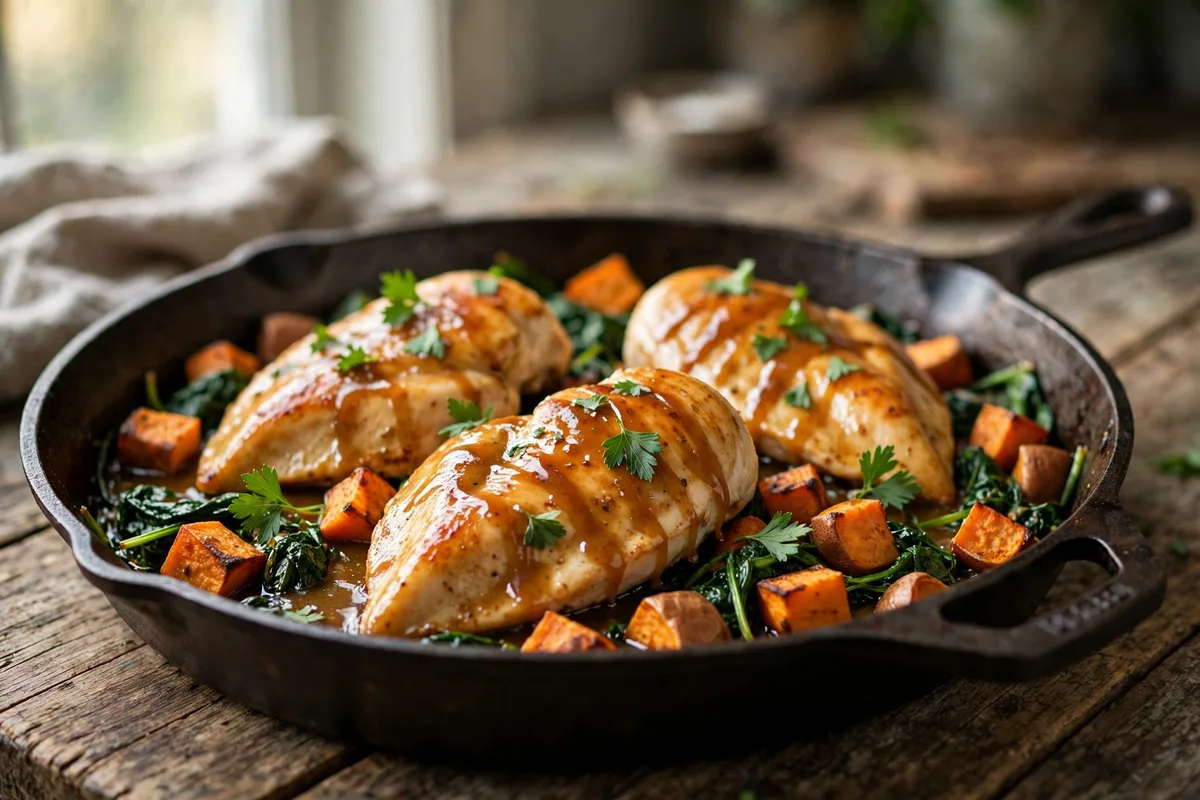
One-Pan Maple Dijon Chicken with Sweet Potatoes (30 Minutes)
Prep time: 10 minutes (estimate)
Cook time: 20 minutes (estimate)
Total time: 30 minutes (estimate)
Servings: 4
This one-pan maple Dijon chicken with sweet potatoes is a complete stovetop dinner in 30 minutes: golden chicken breasts seared in a large skillet, sweet potatoes simmered until tender in a glossy maple-Dijon sauce, and baby spinach wilted in at the end. There is no oven and no microwave involved.
The angle matters, because most versions of this dish take a different route. The top-ranking recipe for maple Dijon chicken, from Carlsbad Cravings, is 810 days old at the time of research on 17 November 2026 and microwaves its potatoes first. The other page-one results are sheet-pan or oven versions. Here the whole meal stays on the hob: the chicken is seared in the pan, the sweet potatoes cook in the pan in the maple-Dijon sauce, and the spinach wilts in the same pan.
It is also a good fit for Thanksgiving week. Maple and sweet potato are firmly seasonal flavours in late November, and this dish gives you that warm, sweet-savoury combination without a roast or a baking tray. The balance is the point: pure maple syrup brings deep, caramel sweetness, Dijon mustard brings sharpness and a little heat, chicken broth keeps the sauce from becoming too sweet, heavy cream rounds it out, and apple cider vinegar lifts the whole dish at the end.
Recipe at a Glance
Prep time: 10 minutes (estimate)
Cook time: 20 minutes (estimate)
Total time: 30 minutes (estimate)
Servings: 4
Course: Main course
Cuisine: American
Method: Stovetop, one pan
Keyword: maple Dijon chicken
What you get: four golden chicken breasts in a creamy maple-Dijon sauce, with tender sweet potatoes and wilted spinach, all cooked in one large skillet. No oven, no microwave, no separate pot for the potatoes.
Why This Recipe Works
The chicken is seared first, and the sauce is built on that flavour. Browning the chicken creates the browned bits on the base of the pan that give the sauce its savoury depth. Deglazing with chicken broth lifts those bits into the sauce, so nothing is wasted.
The sweet potatoes cook in the sauce, not in water. Dicing the potatoes small, about ½-inch pieces, is what makes the stovetop method work in the time available. At that size they become tender in about 15 minutes of gentle simmering, and they absorb maple and mustard flavour as they cook. Larger chunks would stay hard in the middle while the sauce over-reduced around them.
The sauce is balanced, not just sweet. Maple syrup alone would make a sticky, one-note sauce. Dijon mustard, chicken broth, garlic and a finishing splash of apple cider vinegar keep it savoury and bright, and mustard also helps bind the sauce so the cream, broth and maple come together smoothly.
Equipment
- Large skillet or sauté pan, 12 inches, with a lid
- Instant-read thermometer
- Cutting board and sharp knife
- Vegetable peeler
- Measuring cups and spoons
- Wooden spoon or heatproof spatula
- Tongs
- Small bowl, for mixing the sauce
Ingredients
For the Chicken
- 1½ lb boneless, skinless chicken breasts (4 breasts, about 6 oz each)
- 1 teaspoon kosher salt
- ½ teaspoon black pepper, freshly ground
- ½ teaspoon smoked paprika
- ½ teaspoon dried thyme
- 2 tablespoons olive oil
- 1 tablespoon unsalted butter
For the Maple-Dijon Sauce and Vegetables
- 2 medium sweet potatoes (about 1¼ lb total), peeled and diced into ½-inch pieces
- 4 cloves garlic, minced
- ⅓ cup pure maple syrup
- 3 tablespoons Dijon mustard
- ½ cup low-sodium chicken broth
- ⅓ cup heavy cream
- 1 tablespoon apple cider vinegar
- 3 cups baby spinach (about 3 oz)
- 2 tablespoons chopped fresh parsley, for serving (optional)
Use pure maple syrup, not maple-flavoured syrup or pancake syrup. The flavoured versions are mostly corn syrup with artificial flavouring, and they make the sauce cloyingly sweet without the depth of real maple.
Instructions
- Season the chicken. Pat the chicken breasts dry; dry chicken sears far better than wet chicken. Season both sides with the salt, black pepper, smoked paprika and dried thyme. If the breasts are very thick on one end, pound the thick end gently to an even thickness of about ¾ inch.
- Prepare the potatoes and sauce. Peel the sweet potatoes and dice them into ½-inch pieces, keeping the pieces as even as you can. Mince the garlic. In a small bowl, whisk together the maple syrup, Dijon mustard, chicken broth and heavy cream until smooth.
- Sear the chicken. Heat the olive oil in a large 12-inch skillet over medium-high heat until it shimmers. Add the chicken in a single layer, leaving space between the breasts. Cook for 5 to 6 minutes on the first side without moving them, until deeply golden brown. Turn and cook for a further 4 to 5 minutes. Check the thickest part with an instant-read thermometer: it must reach 165°F (74°C). Transfer to a clean plate, cover loosely with foil, and do not wipe out the pan.
- Build the sauce. Reduce the heat to medium. Add the butter and let it melt, scraping up the browned bits from the base of the pan. Add the garlic and cook for 30 seconds, stirring constantly, until fragrant; do not let it brown, or it will taste bitter. Pour in the maple-Dijon mixture, scrape the base of the pan, and bring to a gentle simmer.
- Cook the sweet potatoes. Add the diced sweet potatoes and stir to coat them in the sauce. Reduce the heat to medium-low, cover, and simmer for 13 to 15 minutes, stirring once or twice, until tender when pierced with a fork. If the sauce thickens too fast, add broth one tablespoon at a time.
- Wilt the spinach. Remove the lid and add the spinach in two handfuls, stirring each into the hot sauce until it wilts, 1 to 2 minutes in total. Stir in the apple cider vinegar.
- Return the chicken. Nestle the rested chicken back into the skillet, spooning sauce and sweet potatoes over the top. Simmer gently for 1 to 2 minutes, just until warmed through. Do not boil hard, or the cream may separate and the chicken may overcook.
- Serve. Remove from the heat and let it stand for 2 minutes. Sprinkle with parsley, if using. Slice the chicken across the grain, or serve whole, and spoon the sweet potatoes, spinach and sauce over each portion. Serve straight from the skillet at the table.
Expert Tips
Cut the potatoes small and keep them even. The ½-inch dice is what makes the timing work: at that size, the potatoes become tender in about 15 minutes. At 1-inch dice they need 25 minutes or more, by which time the sauce will have reduced too far and the chicken will be cold.
Do not move the chicken while it sears. Letting it sit undisturbed for 5 to 6 minutes on the first side builds a deep golden crust. Moving it or turning it early tears the surface and stops browning.
Use a thermometer and taste the sauce. Colour alone is not a reliable guide to doneness; the thickest part should read 165°F (74°C). Taste the sauce before the chicken goes back in — that is the last easy moment to adjust it, as maple syrups vary in sweetness and mustards in sharpness.
Substitutions and Variations
Chicken thighs instead of breasts. Use 4 to 6 boneless, skinless chicken thighs (about 1½ lb total). Sear for 5 minutes per side and still check that the thickest part reaches 165°F (74°C).
No heavy cream. Replace the ⅓ cup heavy cream with an extra ⅓ cup chicken broth and simmer uncovered for 2 to 3 minutes at the end to thicken the sauce slightly. The sauce will be thinner and a little sharper. Half-and-half can be used in the same quantity, but keep the heat gentle, as it splits more easily than cream.
Different greens and vegetables. Replace the spinach with 3 cups of chopped kale, added with the sweet potatoes so it has time to soften, or with Swiss chard, wilted in 2 to 3 minutes. Frozen spinach is not recommended; it releases too much water. Peeled butternut squash, diced to ½ inch, can replace the sweet potatoes and cooks in the same time.
A little heat, and dairy-free. Add ¼ teaspoon of red pepper flakes with the garlic for gentle warmth. For a dairy-free version, replace the butter with a further tablespoon of olive oil and the cream with full-fat coconut milk or extra chicken broth.
Common Mistakes and Troubleshooting
Potatoes still hard after 15 minutes. The pieces were probably cut too large, or the heat was too low for a real simmer.
Sauce too sweet, too thin, or too thick. If it is too sweet, add Dijon mustard a teaspoon at a time, tasting after each addition; a further teaspoon of vinegar also helps. If it is too thin, remove the lid and simmer for 2 to 3 minutes until it coats the back of a spoon. If it is too thick, stir in broth one tablespoon at a time.
Chicken dry, garlic bitter, or cream split. Dry chicken usually means overcooking: remove it as soon as it reaches 165°F (74°C), and return it to the sauce for only 1 to 2 minutes. Bitter garlic means it cooked too long or too hot; it needs only 30 seconds. Cream splits when the sauce boils too hard, so keep it at a gentle simmer.
Serving Suggestions
This is a complete meal on its own, so it needs very little alongside it. Crusty bread is the most useful accompaniment, for mopping up the sauce. A simple green salad with a sharp vinaigrette also works well, because the acidity cuts through the richness of the cream and maple. Steamed green beans or roasted broccoli add a fresh contrast if you want a second vegetable.
For a Thanksgiving-week table, serve the skillet as a main course alongside a salad and bread, and let guests help themselves.
Storage and Reheating
Store leftovers in an airtight container in the fridge for up to 3 days, keeping the chicken, sweet potatoes, spinach and sauce together; separating them dries the chicken out. Cool to room temperature within 2 hours of cooking before refrigerating.
To reheat, place a portion in a skillet over medium-low heat with a splash of chicken broth or water, cover, and warm gently for 5 to 7 minutes until heated through. Reheat only the portion you plan to eat. This dish is not ideal for freezing — the potatoes turn watery, the spinach loses texture, and the cream sauce can separate.
Frequently Asked Questions
Can I make this in the oven instead?
Yes, but the timing changes. Sear the chicken on the hob as described, then transfer the chicken, sauce and sweet potatoes to an ovenproof dish and bake at 400°F (200°C) for 20 to 25 minutes, until the potatoes are tender.
Do I really not need to microwave the potatoes first?
No. Dicing the sweet potatoes into ½-inch pieces removes the need for a microwave step: at that size they cook through in 13 to 15 minutes of simmering in the sauce, covered, on the hob. The top-ranking recipe microwaves its potatoes first; this version avoids that step, and the potatoes pick up more flavour by cooking in the sauce.
Can I use chicken thighs instead of breasts?
Yes. Use 4 to 6 boneless, skinless chicken thighs, about 1½ lb in total. Sear for about 5 minutes per side and check the thickest part with an instant-read thermometer: it must reach 165°F (74°C), the same as for breasts.
Is this recipe gluten-free?
Yes, as written, provided your Dijon mustard, chicken broth and maple syrup are labelled gluten-free. Some chicken broths contain gluten, so check the label. Serve it without bread, or with gluten-free bread, to keep the meal gluten-free.
Can I make it ahead of time?
You can prepare parts of it ahead, but it is best cooked fresh. The sweet potatoes can be peeled and diced up to a day ahead and stored in cold water in the fridge; drain them well before cooking. The sauce mixture can be whisked together a few hours ahead and kept covered in the fridge.
What can I use instead of maple syrup?
Honey is the closest substitute, used in the same quantity, but it is sweeter and less complex than maple, so the sauce may need an extra teaspoon of Dijon mustard or vinegar to balance it. This honey mustard chicken and potatoes recipe uses honey and mustard in a similar one-pan format.
Nutrition
The figures below are estimates only, calculated from the ingredient quantities in this recipe for one serving out of four. They are not measured laboratory values, and they will vary with the exact size of the chicken breasts and the brand of broth and mustard.
Per serving (estimate): 482 calories, 38 g protein, 34 g carbohydrate, 20 g fat, 7 g saturated fat, 4 g fibre, 16 g sugar, 520 mg sodium.
Related Recipes
If you enjoyed this one-pan chicken dinner, these recipes from Tasty Trends Recipes use a similar format and a similar sweet-savoury balance.
- One-Pan Apple Cider Chicken Skillet — chicken in a cider pan sauce with apples, a good autumn alternative when you want fruit rather than sweet potatoes.
- One-Pan Honey Mustard Chicken and Potatoes — a honey and mustard one-pan chicken with potatoes, the closest match if you prefer honey to maple syrup.
- One-Pan Balsamic Chicken and Brussels Sprouts — chicken in a tangy balsamic sauce with Brussels sprouts, a sharper, less sweet option in the same 30-minute one-pan style.
Keep the potato dice small, sear the chicken properly, taste the sauce before the chicken goes back in, and serve it straight from the skillet while the sauce is still glossy.