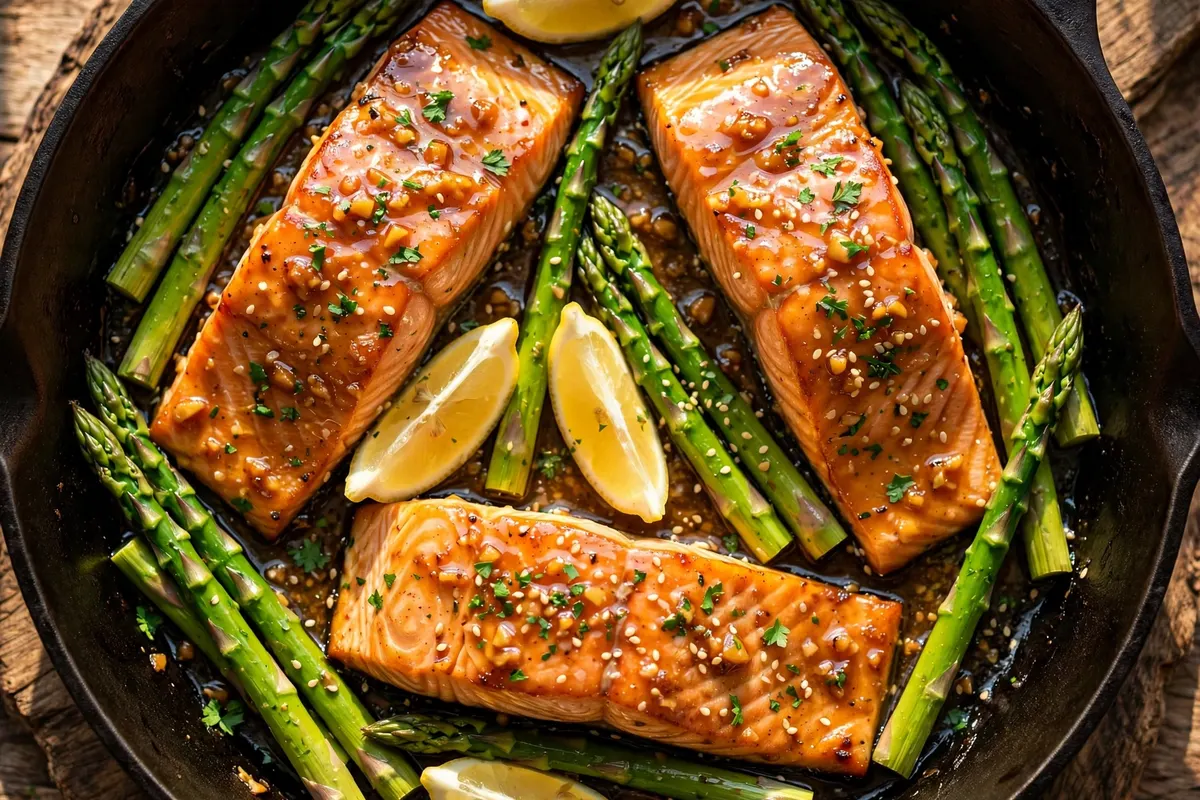
One-Pan Honey Garlic Salmon and Asparagus (30 Minutes)
This one-pan honey garlic salmon and asparagus gets dinner on the table in about 30 minutes, all on the hob — no oven, no broiler, no baking tray. Salmon fillets are seared in a hot skillet until the skin is crisp and the flesh flakes easily, then a honey-garlic butter glaze is built in the same pan. Asparagus spears cook in that same glossy sauce, and the whole thing is finished with lemon and fresh parsley, served straight from the skillet.
Honey garlic salmon is one of the most-searched salmon recipes online, but look at the first page of Google right now and you will notice a pattern: every leading recipe finishes under the broiler or in the oven. The freshest real recipe on page one is 86 days old, the next is 186 days old, then 242 days old, and the two after that are over a year old — and all of them send the salmon to the oven or the grill to finish. None of them is a true stovetop-only dinner. This version fills that gap: the salmon sears on the hob, the glaze thickens in the pan, the asparagus cooks in the sauce, and the oven never gets switched on.
Why This Recipe Works
- A genuine 30 minutes, all on the hob. The salmon sears in about 7 minutes and the asparagus cooks in the glaze in about 4 minutes. No preheating, no broiler, no roasting tray — the gap this recipe was written to fill.
- The glaze is built in the same pan. Butter, garlic, honey, soy sauce and lemon go into the hot skillet after the salmon comes out, picking up the browned bits the fish left behind. The sauce tastes deeper than a glaze whisked in a separate bowl.
- The asparagus cooks in the sauce, not beside it. The spears simmer in the honey-garlic glaze, taking on its sweet and savoury flavour — and their bright green colour against the glossy salmon makes the dish look as good as it tastes.
Recipe at a Glance
- Prep time: 10 minutes (estimate)
- Cook time: 20 minutes (estimate)
- Total time: 30 minutes (estimate)
- Servings: 4
- Course: Main dish
- Cuisine: American
- Difficulty: Easy
Equipment
- Large 12-inch skillet (stainless steel or cast iron both work well; non-stick works too, though the glaze will be a little less deeply browned)
- Instant-read thermometer
- Tongs or a fish spatula
- Small bowl for whisking the glaze
- Sharp knife and cutting board
- Measuring cups and spoons
- Paper towels
Ingredients
For the salmon and asparagus
- 4 salmon fillets (about 6 oz / 170 g each; 1 1/2 lb total), skin-on, pin bones removed
- 1 lb asparagus, woody ends trimmed, spears cut in half crosswise if longer than the pan
- 1 teaspoon kosher salt
- 1/2 teaspoon black pepper
- 2 tablespoons olive oil
For the honey-garlic butter glaze
- 2 tablespoons unsalted butter
- 3 cloves garlic, finely minced
- 3 tablespoons honey
- 2 tablespoons low-sodium soy sauce
- 1 tablespoon fresh lemon juice
- 1 teaspoon lemon zest
- 1/2 teaspoon red pepper flakes (optional, for a little warmth)
To serve
- 2 tablespoons chopped fresh parsley
- 1 teaspoon sesame seeds (optional)
- Lemon wedges, for squeezing over the top
Instructions
- Prepare the salmon and asparagus. Pat the 4 salmon fillets very dry on all sides with paper towels — a dry surface is what lets the skin crisp instead of steam. Season the flesh side of each fillet evenly with 1 teaspoon kosher salt and 1/2 teaspoon black pepper. Trim the woody ends from 1 lb asparagus (bend a spear until it snaps and use that as your guide for the rest), and cut the spears in half crosswise if they are longer than your skillet.
- Whisk the glaze. In a small bowl, whisk together 3 tablespoons honey, 2 tablespoons low-sodium soy sauce, 1 tablespoon fresh lemon juice, 1 teaspoon lemon zest and 1/2 teaspoon red pepper flakes (if using) until smooth. Keep it beside the hob — the garlic step moves fast.
- Heat the pan and sear the salmon skin side down. Heat 2 tablespoons olive oil in a large 12-inch skillet over medium-high heat until it shimmers, about 2 minutes. Lay the seasoned fillets in the pan skin side down in a single layer, leaving space between them. Press each fillet gently with a spatula for the first 10 seconds so the skin makes full contact with the pan. Do not move them. Sear for 4 to 5 minutes, until the skin is crisp and golden and the flesh has turned opaque about two-thirds of the way up.
- Flip and finish the sear. Turn the fillets with tongs or a fish spatula and sear the flesh side for 2 to 3 minutes, until the top is lightly caramelised. The salmon will not be fully cooked yet — it finishes in the glaze. Transfer the fillets to a plate, skin side up, and leave them to rest. Do not wipe out the pan.
- Build the glaze in the same pan. Turn the heat down to medium. Add 2 tablespoons unsalted butter to the skillet and let it melt, scraping the bottom of the pan to lift up the browned bits the salmon left behind. Add 3 cloves finely minced garlic and cook for 30 seconds, stirring constantly, until fragrant.
- Add the honey-garlic mixture and thicken it. Pour in the whisked honey, soy sauce, lemon juice, zest and red pepper flakes. Simmer for 1 to 2 minutes, stirring, until it thickens enough to coat the back of a spoon. If it thickens too fast, add a tablespoon of water and stir.
- Cook the asparagus in the glaze. Add the trimmed 1 lb asparagus to the skillet in a single layer, turning the spears with tongs so each one is coated in the glaze. Cook for 3 to 4 minutes, turning once, until the spears are bright green and tender-crisp. Thin spears may need only 3 minutes; thick spears may need 4 to 5.
- Return the salmon to the pan. Slide the seared fillets back into the skillet, skin side up, nestling them among the asparagus, with any juices from the plate. Spoon the glaze generously over each fillet and simmer gently for 1 to 2 minutes, until the salmon is heated through and the glaze clings to the fish.
- Check the temperature and rest. Check the thickest part of the largest fillet with an instant-read thermometer — it should read at least 145°F / 63°C, and the flesh should flake easily with a fork. If it reads lower, give the salmon another minute in the glaze and check again. Remove the pan from the heat and rest for 2 to 3 minutes.
- Serve. Scatter over 2 tablespoons chopped fresh parsley and 1 teaspoon sesame seeds (if using). Serve straight from the skillet with lemon wedges, spooning the remaining glaze over the salmon and asparagus.
Expert Tips
- Dry salmon crisps; wet salmon steams. Pat the fillets very dry before seasoning. Any surface moisture has to boil off before browning and crisping can start, and in 4 to 5 minutes per side there is no time to spare.
- Start the salmon skin side down and leave it alone. The skin needs uninterrupted contact with the hot pan to crisp. Press it down for the first 10 seconds, then do not move the fillet until the flesh has turned opaque two-thirds of the way up.
- Watch the garlic, not the clock. Garlic goes from fragrant to bitter in under a minute. Have the glaze bowl ready before the garlic goes in, so the honey mixture hits the pan the moment the garlic smells sweet.
- Do not let the honey burn. Honey caramelises fast over high heat. That is why the heat comes down to medium before the glaze is built — a scorched honey glaze tastes bitter, and there is no fixing it once it burns.
- Pull the salmon at 145°F / 63°C, not beyond. Salmon keeps cooking as it rests, so pulling it right at the safe temperature keeps it moist. Use an instant-read thermometer in the thickest part of the largest fillet.
Substitutions & Variations
- Swap the fish. Thick cod, halibut or sea bass fillets work with the same method — sear 3 to 4 minutes per side and cook to the same 145°F / 63°C. Avoid thin fillets like sole, which fall apart in the pan.
- Make it spicier. Add 1 teaspoon sriracha to the glaze, or double the red pepper flakes to 1 teaspoon. The heat balances the honey's sweetness nicely.
- Swap the asparagus. Green beans cook in the glaze in the same 3 to 4 minutes. Broccolini needs 4 to 5 minutes, so add it a minute before the salmon returns.
- Gluten-free version. Use tamari or a certified gluten-free soy sauce in place of the soy sauce. Everything else is naturally gluten-free.
- Dairy-free version. Replace the 2 tablespoons unsalted butter with 2 tablespoons olive oil. The glaze will be slightly less rich, but the honey and garlic carry the flavour.
Common Mistakes
- Putting wet salmon in the pan. Skipping the paper-towel step is the most common reason the skin sticks and never crisps. Dry the fillets thoroughly, on both sides, before they touch the oil.
- Moving the salmon while it sears. Shifting the fillets breaks the contact that creates crisp skin. Put them down, press once, and leave them until the flesh is opaque two-thirds of the way up.
- Burning the garlic. Garlic in a hot pan with butter goes bitter in seconds. Keep the heat at medium and have the glaze bowl within reach, so the honey mixture goes in the moment the garlic smells sweet.
- Overcooking the salmon. Salmon goes from silky to dry in about a minute past 145°F / 63°C. Pull the fillets at temperature and let the resting time finish the job.
- Overcooking the asparagus. Asparagus in a hot glaze goes from bright green and tender-crisp to dull and limp quickly. Three to four minutes is enough — the spears should still have a little bite.
Serving Suggestions
This is a complete one-pan dinner as it stands, but it welcomes company. Steamed jasmine rice or fluffy couscous is the first thing to put on the table — both soak up the honey-garlic glaze beautifully. Crusty bread works the same way, for mopping up the sauce left in the pan. For a lighter plate, serve with a simple cucumber salad. Serve straight from the skillet at the centre of the table — it keeps everything warm and saves washing a serving dish.
Storage and Reheating
Let leftovers cool to room temperature, then store the salmon and asparagus in an airtight container with the glaze spooned over the top — the glaze keeps the fish from drying out in the fridge. They keep for 2 to 3 days refrigerated. To reheat, warm gently in a covered skillet over low heat with a splash of water for 3 to 4 minutes, until heated through to 145°F / 63°C. Avoid the microwave: it reheats unevenly and dries out the salmon.
To freeze, place cooled salmon and glaze in a freezer-safe container for up to 2 months — freeze the asparagus separately, as it softens considerably after freezing. Defrost overnight in the fridge, then reheat gently in a covered skillet as above, with fresh lemon and parsley to brighten it back up.
Frequently Asked Questions
Can I make honey garlic salmon without an oven?
Yes — that is the whole point of this version. The salmon sears in about 7 minutes, the glaze thickens in about 2 minutes, and the asparagus cooks in the sauce in about 4 minutes, all in one skillet on the hob. No preheating, no broiler, no roasting tray.
What temperature should salmon be cooked to?
Salmon should reach at least 145°F / 63°C, measured with an instant-read thermometer in the thickest part of the largest fillet. The flesh should flake easily with a fork. Pull it right at 145°F / 63°C — it keeps cooking gently as it rests.
Do I need to remove the skin from the salmon?
No — keep it on. The skin protects the flesh, helps the fillet hold together, and crisps into one of the best parts of the dish. Sear skin side down first. Skinless fillets work too, but sear them for a minute less per side.
Can I use frozen salmon fillets?
You can, but defrost them fully first — overnight in the fridge is best. A partly frozen fillet will not sear properly and the outside will overcook before the centre reaches 145°F / 63°C. Pat the defrosted fillets very dry before seasoning.
Why is my honey-garlic glaze bitter?
The glaze almost certainly scorched. Honey caramelises fast over high heat, and burnt garlic turns bitter in seconds. Build the glaze over medium heat and add the honey mixture the moment the garlic smells sweet.
Can I make this recipe ahead of time?
It is best served fresh, but you can whisk the glaze and trim the asparagus a few hours ahead — keep the glaze in a covered bowl in the fridge and the asparagus in a damp paper towel. Season and sear the salmon just before serving.
Is this recipe gluten-free?
As written, no — the soy sauce contains wheat. Swap it for tamari or a certified gluten-free soy sauce and the recipe is gluten-free. It is dairy-free if you replace the butter with olive oil.
Nutrition (Estimates)
Per serving, serves 4, including the glaze and asparagus. Estimates from standard ingredient values, not laboratory-tested figures.
- Calories: about 460 kcal
- Protein: about 35 g
- Carbohydrates: about 14 g
- Fat: about 29 g
- Saturated fat: about 6 g
- Sodium: about 520 mg
- Sugar: about 12 g
The figures are internally consistent: 35 g protein × 4 kcal + 14 g carbohydrates × 4 kcal + 29 g fat × 9 kcal = 457 kcal, which matches the stated estimate of about 460 kcal.
Related Recipes
If you like quick one-pan seafood dinners, these use the same skillet-first approach: the One-Pan Lemon Butter Tilapia with Asparagus (30 Minutes), the One-Pan Maple Glazed Salmon and Brussels Sprouts Skillet (30 Minutes), and the One-Pan Shrimp Fajitas (30 Minutes).
Video omitted because no verified, relevant video would materially improve this article.