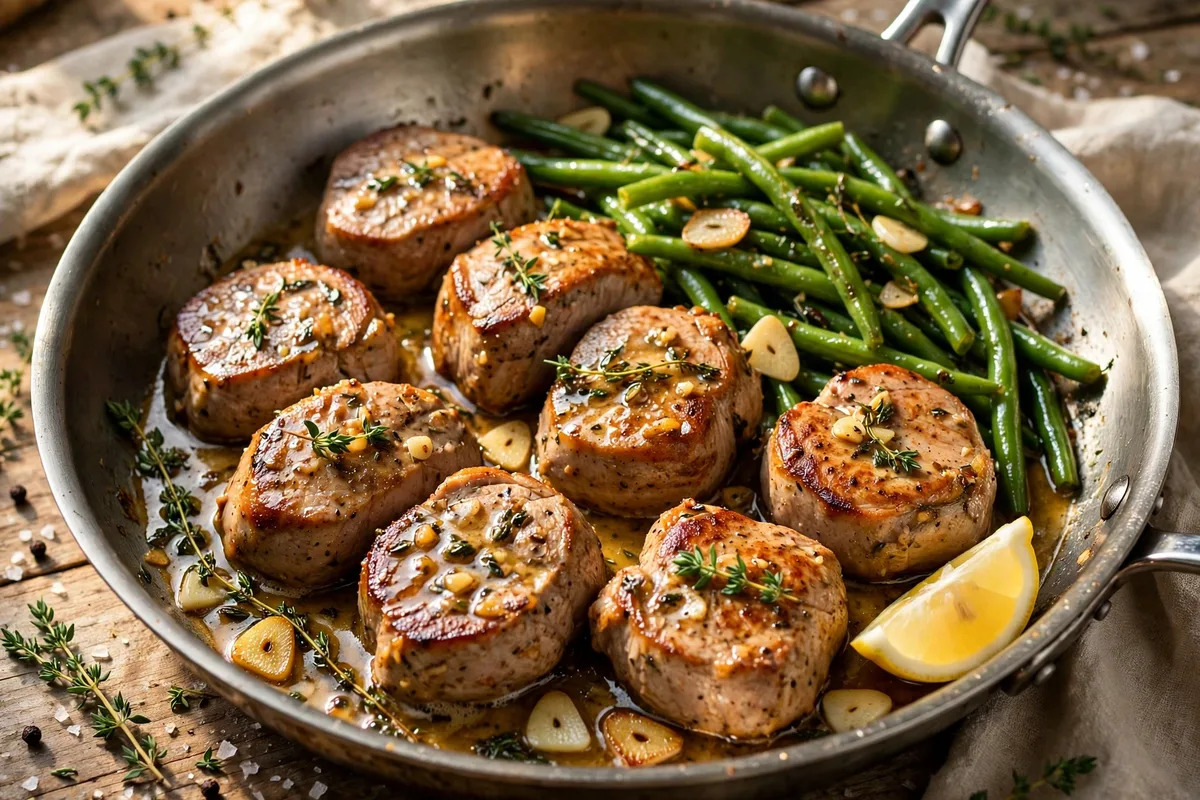
One-Pan Garlic Butter Pork Tenderloin Medallions (30 Minutes)
Pork tenderloin is one of the best weeknight cuts there is, but only if you cook it the right way. Roast it whole and dinner takes the better part of an hour; slice it into thick medallions and the same cut sears in minutes, picks up a deep golden crust, and finishes in a garlic butter sauce in the same pan — with green beans cooking alongside it. Dinner is on the table in about 30 minutes, and there is only one pan to wash.
This is a true stovetop recipe, and that is exactly the gap it fills. On page one of Google for garlic butter pork tenderloin medallions, the only direct pan-seared medallion recipe was nearly a year old, the freshest were a whole roasted tenderloin and a Tuscan orzo version, and the other page-one result was a sheet-pan roast. None of them is a fast stovetop medallion dinner with the vegetables cooked in the same pan. This one is: sliced tenderloin, seared hard and finished in a glossy garlic butter pan sauce, with green beans simmered in the same pan.
Why This Recipe Works
Pork tenderloin is the leanest, most tender cut of pork, and it rewards fast, hot cooking. With very little fat and almost no connective tissue, it goes from juicy to dry in minutes — which is why the medallion cut matters. Slicing the tenderloin into 1-inch rounds gives every piece two broad flat faces that make full contact with the pan, so they brown deeply and quickly while the centres stay tender.
The pork sears first and comes out, and the sauce is built in the same skillet while it rests. The browned bits left behind by the sear dissolve into chicken broth, Dijon mustard and lemon juice to make a pan sauce with real depth, and the butter goes in last so the sauce turns glossy rather than greasy. The green beans cook in that sauce, covered, for four to five minutes — exactly long enough to turn crisp-tender and absorb the garlic butter flavour.
Recipe at a Glance
Prep time: 10 minutes (estimate)
Cook time: 20 minutes (estimate)
Total time: 30 minutes (estimate)
Servings: 4
Course: Main course
Cuisine: American
Difficulty: Easy
Method: Stovetop only — no oven required
All times are estimates. Cooking time depends on slice thickness, pan heat and the starting temperature of the pork, so use the visual cues and the thermometer reading rather than the clock alone.
Equipment
- Large 12-inch skillet — stainless steel or cast iron. A 12-inch pan gives the medallions room to sear without crowding.
- Sharp knife — for slicing the tenderloin into even 1-inch medallions.
- Tongs — for turning the medallions.
- Instant-read thermometer — to confirm the pork has reached 145°F (63°C).
- Lid for the skillet — for the short covered cook that steams the green beans in the sauce.
Ingredients
For the pork medallions
- 1 1/2 lb (680 g) pork tenderloin — one large tenderloin, or two smaller ones totalling the same weight. Trim off the silverskin (the thin, shiny membrane) before slicing — it does not soften in cooking and will make the medallions curl.
- 1 teaspoon kosher salt — if you only have fine table salt, use 3/4 teaspoon.
- 1/2 teaspoon black pepper — freshly ground if you have it.
- 1/2 teaspoon garlic powder — this seasons the pork, separate from the sliced garlic in the sauce.
- 1/2 teaspoon smoked paprika — adds warmth and helps the crust colour.
- 2 tablespoons olive oil — for searing. Its higher smoke point lets the pork brown properly before the butter goes in.
For the garlic butter sauce and green beans
- 3 tablespoons unsalted butter — divided: 1 tablespoon to bloom the garlic, 2 tablespoons swirled in at the end to finish the sauce. Unsalted butter lets you control the salt.
- 6 cloves garlic, thinly sliced — sliced, not minced. Slices soften into the sauce without burning as quickly as minced garlic.
- 1/2 cup low-sodium chicken broth — the base of the pan sauce. Low-sodium matters because the sauce reduces and concentrates as it simmers.
- 1 tablespoon Dijon mustard — adds a gentle tang and helps the sauce cling to the pork.
- 1 tablespoon fresh lemon juice — brightens the sauce and keeps it from feeling heavy.
- 1 tablespoon fresh thyme leaves — stripped from the stems. Half goes into the sauce, half is scattered over the finished dish.
- 1/4 teaspoon red pepper flakes (optional) — a small pinch of warmth; leave it out for a mild sauce.
- 12 oz (340 g) green beans, trimmed — fresh beans, ends trimmed. They cook in the sauce in the same pan.
- Lemon wedges, to serve — for squeezing over the pork at the table.
Instructions
- Trim and slice the pork. Pat the tenderloin dry with paper towels. Trim away the silverskin and any large pieces of fat, then slice crosswise into 8 medallions, each about 1 inch thick. Press any uneven medallion gently with the palm of your hand so the slices are even.
- Season the medallions. In a small bowl, mix together the 1 teaspoon kosher salt, 1/2 teaspoon black pepper, 1/2 teaspoon garlic powder and 1/2 teaspoon smoked paprika. Sprinkle evenly over both sides of all 8 medallions.
- Heat the pan. Place a large 12-inch skillet over medium-high heat. Add the 2 tablespoons olive oil and let it heat until it shimmers — about 1 to 2 minutes. The pan must be properly hot before the pork goes in, or the meat will steam instead of searing.
- Sear the medallions. Lay the medallions in the pan in a single layer, leaving a little space between them, and do not move them for 3 to 4 minutes. Look for a deep golden-brown crust and edges turning opaque a third of the way up. Flip with tongs and sear the second side for a further 3 to 4 minutes, until equally browned. If your pan is smaller than 12 inches, sear in two batches — crowded pork steams, and steamed pork does not brown.
- Check the temperature and rest the pork. Check the thickest medallion with an instant-read thermometer. You are aiming for 145°F (63°C) — the safe minimum temperature for pork, after which a 3-minute rest is required. The medallions will rise a degree or two as they rest, so you can pull them at 143–145°F (62–63°C). Transfer them to a plate while you build the sauce.
- Bloom the garlic. Reduce the heat to medium. Add 1 tablespoon of the unsalted butter to the same skillet and let it melt, scraping the bottom of the pan as it does. Add the 6 sliced garlic cloves and cook for 30 to 60 seconds, stirring constantly, until fragrant and just starting to turn golden at the edges. Do not let it brown deeply; garlic turns bitter quickly.
- Build the pan sauce. Pour in the 1/2 cup low-sodium chicken broth, the 1 tablespoon Dijon mustard, the 1 tablespoon fresh lemon juice and the 1/4 teaspoon red pepper flakes, if using. Stir well, scraping up the browned bits, and simmer for about 1 minute.
- Cook the green beans in the sauce. Add the 12 oz trimmed green beans and toss to coat in the sauce. Cover and cook for 4 to 5 minutes, until the beans are bright green and crisp-tender — they should bend without snapping, but still have a definite bite.
- Finish the sauce and return the pork. Uncover the pan and stir in the remaining 2 tablespoons unsalted butter and half of the 1 tablespoon fresh thyme leaves. Swirl until the butter melts and the sauce turns glossy. Return the medallions to the skillet, nestling them among the beans, along with any juices from the plate. Spoon the sauce over the pork and simmer gently for 1 to 2 minutes, until the pork is heated through and the sauce clings to the medallions.
- Rest and serve. Remove the pan from the heat and let the pork rest in the pan for 3 minutes — this completes the 145°F (63°C) safety guidance and lets the juices settle. Scatter the remaining thyme leaves over the top and serve straight from the skillet, with lemon wedges on the side.
Expert Tips
- Dry pork browns; wet pork steams. Patting the medallions dry before seasoning is the single most important step for a good crust. Surface moisture has to boil off before browning can start, by which time the pork is already overcooking.
- Do not move the medallions while they sear. The crust forms where the meat stays in contact with the hot pan. Leave them alone for the full 3 to 4 minutes per side.
- Use the thermometer, not the colour. Pork can look done before it is safe, and it can still be pink at 145°F (63°C) — a blush of pink in the centre at that temperature is normal and safe.
- Add the butter last. Butter added too early in a hot pan browns and can split the sauce. Adding the final 2 tablespoons off the fiercest heat is what gives you a glossy, spoonable sauce instead of an oily one.
Substitutions and Variations
- No green beans? Asparagus spears, trimmed and cut into 2-inch pieces, cook in the same 4 to 5 minutes. Sugar snap peas need only 2 to 3 minutes, so add them later.
- Herb swaps. Fresh rosemary or sage can replace the thyme. Use half as much rosemary — it is stronger — and add it with the garlic.
- A richer sauce. Swap half the chicken broth for dry white wine, or stir in 2 tablespoons of cream with the final butter for a creamier finish.
- Make it spicier. Double the red pepper flakes to 1/2 teaspoon, or add a pinch of cayenne with the dry seasoning.
- Garlic lovers. Add 2 extra sliced cloves with the first 6 — 8 cloves total — for a more assertive garlic sauce. Keep them sliced so they do not burn.
Common Mistakes
- Skipping the rest. Cutting into the pork straight off the heat lets the juices run out onto the board. The 3-minute rest finishes the pork to a safe temperature and keeps it juicy.
- Cooking past 145°F (63°C). Pork tenderloin dries out fast once it passes 150°F (66°C). Pull the medallions at 145°F (63°C) and let the rest do the rest.
- Crowding the pan. Eight medallions need space. If they are touching, moisture gets trapped between them and the crust never forms. Use a 12-inch pan, or sear in two batches.
- Burning the garlic. Sliced garlic goes from golden to bitter in under a minute. Keep the heat at medium, stir constantly, and have the broth ready to pour in the moment the garlic smells fragrant.
Serving Suggestions
This is a complete one-pan dinner as it stands, but it pairs well with something starchy to catch the sauce. Creamy mashed potatoes are the classic choice; buttered egg noodles or a simple rice pilaf work just as well. Serve it family-style straight from the skillet at the table, with the lemon wedges passed around.
Storage and Reheating
Refrigerator: Store leftover medallions, beans and sauce together in an airtight container for up to 3 days. Keep the sauce with the pork to keep the meat moist.
Freezer: The pork freezes well for up to 2 months in a freezer-safe container or bag, with as much air removed as possible. The green beans will soften, so freeze the pork and sauce on their own if you want the beans to stay crisp.
Reheating: Warm the leftovers gently in a covered skillet over medium-low heat with a splash of chicken broth or water, for 4 to 5 minutes, until the pork reaches 165°F (74°C) throughout. Avoid the microwave — it heats unevenly and can toughen the pork.
Frequently Asked Questions
What temperature should pork tenderloin medallions be cooked to?
Pork should reach 145°F (63°C) in the thickest part, followed by a 3-minute rest — the safe minimum temperature for pork. Use an instant-read thermometer rather than judging by colour: pork at 145°F (63°C) can still have a blush of pink in the centre, which is normal and safe.
How thick should I slice the medallions?
About 1 inch thick. That thickness sears in 3 to 4 minutes per side and reaches 145°F (63°C) without drying out. Thinner slices dry out fast; thicker ones risk a burnt crust before the centre is cooked.
Do I really not need the oven for this recipe?
No oven is needed. The medallions are thin enough to cook through on the stovetop, and the green beans steam in the covered pan in the sauce. That is the point of this version: unlike the whole-roast tenderloin recipes that dominate the search results, this is a genuine stovetop dinner.
Why did my garlic butter sauce split?
Usually because the pan was too hot when the final butter went in, or the sauce was boiled hard afterwards. Keep the heat at medium or below once the butter is in, and take the pan off the heat as soon as the sauce turns glossy.
Can I make this ahead of time?
Partly. You can slice and season the medallions up to a day ahead and keep them covered in the refrigerator, and you can trim the green beans and slice the garlic in advance. Cook the dish fresh, though — seared pork and a butter sauce do not hold well.
Nutrition
Estimated per serving (serves 4), including the garlic butter sauce and green beans: about 385 calories, 21 g fat, 10 g carbohydrates, 39 g protein. These are estimates from the listed ingredients, not laboratory-tested values. The figures are internally consistent: 39 g protein × 4 + 10 g carbohydrates × 4 + 21 g fat × 9 = 385 kcal.
Related Recipes
If you enjoyed this one-pan pork dinner, try these:
- One-Pan Honey Mustard Pork Chops — another 30-minute stovetop pork dinner, with a sweet mustard glaze.
- One-Pan Garlic Butter Steak Bites and Potatoes — the same garlic butter pan-sauce idea, with steak bites and potatoes.
- One-Pan Teriyaki Chicken and Vegetables — a 30-minute one-pan chicken dinner with vegetables cooked in the sauce.