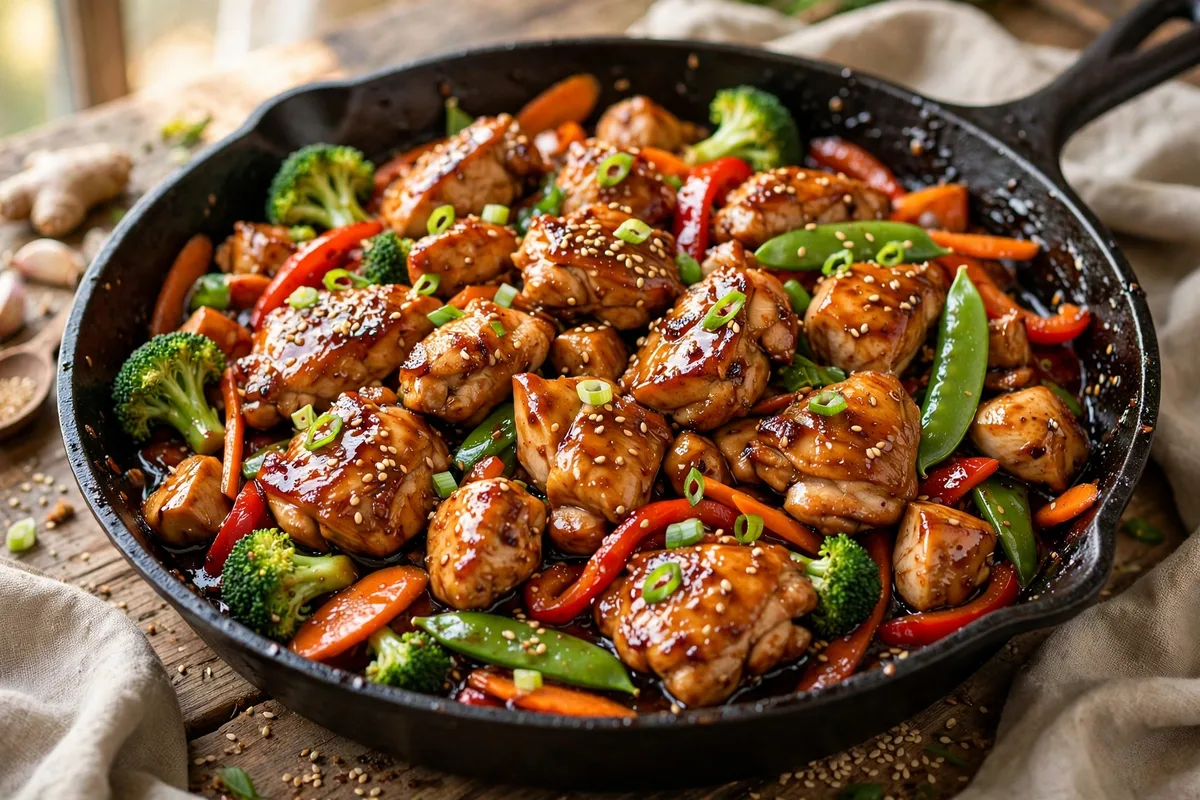
One-Pan Teriyaki Chicken and Vegetables (30 Minutes)
This one-pan teriyaki chicken and vegetables is a true stovetop skillet dinner: chicken thighs seared until golden, broccoli, bell pepper, snap peas and carrots stir-fried in the same pan, and a homemade teriyaki glaze — soy sauce, honey, rice vinegar, ginger, garlic and sesame — thickened right in the pan so it coats every piece. No oven is involved, and the whole thing is on the table in about 30 minutes.
Most versions of this dish online are sheet-pan bakes. That works, but it is a different meal: the oven roasts everything at once, the sauce goes on at the end, and the chicken never gets the deep, caramelised crust that only direct contact with a hot pan can give. This version keeps everything on the hob, in one pan, in the order that matters — chicken first, vegetables second, sauce last.
Prep: 10 minutes (estimate) | Cook: 20 minutes (estimate) | Total: 30 minutes (estimate) | Servings: 4 | Method: stovetop skillet, no oven
Why This Recipe Works
A good teriyaki stir-fry is a question of sequence. Chicken thighs go into a hot, oiled pan first and are left alone long enough to brown properly. That browning — the Maillard reaction — is where most of the flavour comes from, and it only happens when the pan is hot and the chicken is dry and undisturbed for the first few minutes. Crowding the pan or stirring too early steams the chicken instead, and steamed chicken never browns.
The vegetables follow in the same pan, in the order of how long each one needs: carrots first because they are the firmest, broccoli and bell pepper next, snap peas last because a minute is all they need. Cooking them in stages means nothing turns soggy, and each vegetable keeps its own colour and bite, while the browned bits left behind by the chicken dissolve into the vegetables as they cook.
The sauce is made from pantry staples and thickened in the pan with a small cornstarch slurry. A thin sauce slides off the chicken and pools at the bottom of the pan; a sauce thickened in the pan clings, glazes, and turns glossy in about two minutes. The balance is deliberate: soy sauce for salt and depth, honey for sweetness and shine, rice vinegar for brightness, fresh ginger and garlic for warmth, and sesame oil for the nutty note that makes it smell like teriyaki rather than just sweet soy sauce. Low-sodium soy sauce is specified because the sauce reduces as it thickens.
Ingredients
Everything below serves 4. Read through the list once before you start; the cooking moves quickly once the pan is hot, and having everything cut and measured in advance is what keeps this a 30-minute dinner.
For the chicken and vegetables
- 1½ lb (680 g) boneless, skinless chicken thighs, cut into bite-sized pieces
- ½ teaspoon fine sea salt
- ¼ teaspoon ground black pepper
- 1 tablespoon vegetable oil
- 2 medium carrots, peeled and cut into thin matchsticks
- 2 cups (about 200 g) broccoli florets, cut into small, even pieces
- 1 red bell pepper, deseeded and sliced into thin strips
- 1 cup (about 110 g) sugar snap peas, strings removed
- 3 green onions, thinly sliced
- 1 tablespoon sesame seeds
For the homemade teriyaki sauce
- ⅓ cup (80 ml) low-sodium soy sauce
- 3 tablespoons honey
- 2 tablespoons rice vinegar
- 1 tablespoon grated fresh ginger
- 3 garlic cloves, finely minced
- 1 tablespoon sesame oil
- 1 teaspoon cornstarch, mixed with 1 tablespoon cold water to make a slurry
A note on the ingredients. Cut the chicken into pieces of roughly the same size — about 1½ inches — so they cook at the same rate, and cut the broccoli florets small, no wider than about an inch across. Fresh ginger is worth using: it gives a warm, bright heat that ground ginger cannot match. If you only have ground ginger, use ½ teaspoon, but expect a flatter result. For a gluten-free version, use tamari or a certified gluten-free soy sauce in the same ⅓-cup quantity; the rest of the recipe is naturally gluten-free.
Equipment
A large, deep 12-inch skillet or sauté pan, a chopping board and sharp knife, a small bowl and whisk for the sauce, tongs or a wooden spoon, and an instant-read thermometer — the reliable way to confirm the chicken is done.
Instructions
- Whisk the sauce. In a small bowl, whisk together the ⅓ cup (80 ml) low-sodium soy sauce, 3 tablespoons honey, 2 tablespoons rice vinegar, 1 tablespoon grated fresh ginger, 3 minced garlic cloves and 1 tablespoon sesame oil until the honey has dissolved. In a separate tiny bowl, stir the 1 teaspoon cornstarch into 1 tablespoon cold water until smooth, and set the slurry aside. Having both ready before the pan gets hot is the whole trick to this recipe — once the vegetables are in, there is no time to measure.
- Season and dry the chicken. Pat the 1½ lb (680 g) of chicken thigh pieces dry with paper towels, then season evenly with the ½ teaspoon salt and ¼ teaspoon black pepper. Drying matters: wet chicken steams, dry chicken browns. Wash your hands and the board before they touch anything else — raw chicken should never share a surface with the vegetables you are about to eat.
- Sear the chicken. Heat the 1 tablespoon vegetable oil in the skillet over medium-high heat until it shimmers — about 2 minutes. Add the chicken in a single layer, leaving space between the pieces; if your pan is smaller than 12 inches, sear in two batches, as crowded chicken will not brown. Leave the pieces untouched for 3 to 4 minutes until the undersides are deeply golden, then turn and cook for another 3 to 4 minutes until the other side is browned. Transfer to a clean plate; the chicken will finish cooking in the sauce later.
- Start the vegetables. Add the 2 medium carrots, cut into matchsticks, to the same pan — no extra oil needed — and stir-fry for about 2 minutes, scraping up the browned bits from the bottom as you go.
- Add the broccoli and pepper. Add the 2 cups (about 200 g) broccoli florets and the sliced red bell pepper. Stir-fry for about 3 minutes, stirring every 30 seconds or so, until the broccoli turns bright green and the pepper strips begin to soften but still hold their shape. If the pan looks dry, add a tablespoon of water — not more oil.
- Add the snap peas. Add the 1 cup (about 110 g) sugar snap peas and stir-fry for 1 minute more. They should turn vivid green and stay crisp; snap peas go from perfect to limp in under a minute.
- Return the chicken and add the sauce. Return the seared chicken and any juices from the plate to the pan. Give the sauce a quick re-whisk — the honey settles — and pour it over everything. Stir to coat, then let it come to a gentle simmer, about 1 minute.
- Thicken and finish. Stir the cornstarch slurry once more, then drizzle it into the simmering sauce while stirring. Within 1 to 2 minutes the sauce will turn glossy and thick enough to coat the back of a spoon. Check the largest piece of chicken with an instant-read thermometer: it must read 165°F (74°C) at the thickest part. If it reads lower, simmer for another minute and check again. Do not let the sauce boil hard, or the honey can scorch and turn bitter.
- Garnish and serve. Take the pan off the heat. Scatter over the 3 sliced green onions and the 1 tablespoon sesame seeds, toss once, and serve immediately over rice or noodles.
Expert Tips
Do not move the chicken too soon. If a piece resists when you try to turn it, it is not ready — browned chicken releases from the pan on its own. Give it another minute.
Cut everything before the hob goes on. There is no natural pause in the middle of this recipe to chop a pepper. Having everything cut, measured and within reach is the difference between crisp vegetables and overcooked ones.
Keep the pan hot, but not smoking. If the pan is too cool, the vegetables steam and go soft; if it is smoking, the garlic in the sauce will burn the moment it hits the pan.
Thin the sauce rather than overcooking the chicken. If the glaze gets too thick before the chicken reaches 165°F (74°C), add a tablespoon of water and stir — never add more soy sauce, which will make the dish saltier. If the sauce still looks thin after 2 minutes of simmering, give the slurry another stir and add half of it again. Do not rinse the pan between stages: the browned bits left after searing are concentrated flavour.
Variations
With chicken breast. Swap the thighs for 1½ lb (680 g) boneless, skinless chicken breast, cut the same way. Sear for 2 to 3 minutes per side instead of 3 to 4, and pull it at exactly 165°F (74°C) and no higher — breast dries out faster than thigh.
Spicier. Add 1 to 2 teaspoons of sriracha or ½ teaspoon of chilli flakes to the sauce in step 1.
Different vegetables. The method holds for almost any quick-cooking vegetable. Swap the snap peas for green beans — add them with the broccoli, as they need the extra minute — or add a cup of sliced mushrooms with the carrots. Courgette works too; add it with the bell pepper.
Pineapple teriyaki. Add 1 cup of fresh pineapple chunks with the snap peas in step 6. The pineapple softens slightly, picks up the glaze, and adds a sweet-tart note.
Serving Suggestions
Steamed jasmine rice is the natural partner: it soaks up the glaze, and a mound of rice under the chicken and vegetables turns this into a complete dinner with nothing else needed. Brown rice works too, though it takes longer to cook, so start it before you touch the chicken. For a lighter meal, serve over cauliflower rice or rice noodles — the sauce clings to noodles particularly well. A cucumber salad dressed with rice vinegar cuts through the richness of the glaze.
Storage and Reheating
Cool any leftovers within 2 hours of cooking and store them in an airtight container in the fridge for up to 3 days. The vegetables will soften on reheating, but the flavour holds up well, and the dish is still good the next day over fresh rice.
To reheat, warm gently in a skillet over medium heat with a splash of water, stirring, for 3 to 4 minutes until steaming hot throughout. A microwave works too: cover loosely, heat in 60-second bursts, and stir between bursts. Freezing is possible but not ideal — the sauce and chicken freeze well for up to 2 months, but the vegetables turn soft on thawing. If you do freeze it, thaw overnight in the fridge. Do not refreeze leftovers that have already been thawed and reheated.
Frequently Asked Questions
Can I use chicken breast instead of thighs?
Yes. Use the same weight — 1½ lb (680 g) — cut the same way, but sear for 2 to 3 minutes per side rather than 3 to 4, and check the temperature early. Breast dries out faster than thigh, so pull it the moment the thickest piece reads 165°F (74°C).
Can I use frozen vegetables?
You can, but the result will be softer and the pan will be wetter. Thaw the vegetables first and pat them as dry as you can, then add them in the same order and cook for an extra minute at each stage. Frozen broccoli is the best candidate; frozen snap peas tend to go limp.
Is this recipe gluten-free?
It can be. Swap the ⅓ cup (80 ml) low-sodium soy sauce for the same quantity of tamari or a certified gluten-free soy sauce, and check that your rice vinegar and cornstarch are labelled gluten-free. Everything else in the recipe is naturally gluten-free.
Can I make the teriyaki sauce ahead of time?
Yes. Whisk together the soy sauce, honey, rice vinegar, ginger, garlic and sesame oil — everything except the cornstarch slurry — and keep it in a sealed jar in the fridge for up to 5 days. Make the cornstarch slurry fresh when you cook, as it separates on standing.
How do I keep the vegetables crisp?
Three things: a hot pan, vegetables added in stages, and short cooking times. The carrots get 2 minutes, broccoli and pepper 3, snap peas 1. If your pan is small, cook the vegetables in two batches rather than piling them in at once; a crowded pan steams instead of stir-frying. Serve immediately.
Why did my sauce turn out too thin — or too thick?
Too thin usually means the slurry was added to a sauce that was not simmering, or the cornstarch had settled and was not stirred before adding. The sauce needs to be at a gentle simmer for the starch to activate. Too thick usually means it simmered too long or boiled hard. Fix a thin sauce by stirring the slurry again and adding half of it; fix a thick sauce by stirring in a tablespoon of water at a time until it loosens.
Nutrition
These figures are estimates only, calculated from the listed ingredients for 4 servings, served without rice or noodles. They have not been laboratory tested, and actual values will vary with the brand of soy sauce used.
Per serving (estimate): about 445 calories · 35 g protein · 22 g carbohydrate · 24 g fat · 4 g fibre · 9 g sugars · about 890 mg sodium.
The figures are internally consistent: 35 g protein × 4 kcal + 22 g carbohydrate × 4 kcal + 24 g fat × 9 kcal = 444 kcal, which matches the stated estimate of about 445 calories. Serving the dish over a cup of cooked jasmine rice adds roughly 200 calories and 45 g carbohydrate per serving.
Related Recipes
These three are the closest matches on the blog — same weeknight logic, same 30-minute shape, different flavours:
- One-Pan Honey Garlic Chicken and Green Beans — another stovetop skillet chicken dinner, this one with a honey-garlic glaze and green beans.
- One-Pot Garlic Butter Chicken and Rice — chicken and rice cooked together in one pot, with a garlic-butter finish.
- One-Pan Harvest Chicken Skillet — a late-fall skillet with seasonal vegetables, in the same 30-minute format.
Video omitted because no verified, relevant video would materially improve this article.